
 Tours
 Soft Adventure
 Stargaze
 Dark Sky Astro Experience
 Snowshoe
 Hiking
 Fishing
 Photography
 Activities
 Food and Drink Tours
 Weddings
 Groups
 RMNP Webcam
 Dark Sky Hub
Milky Way Photography in Colorado: How to Plan the Shot
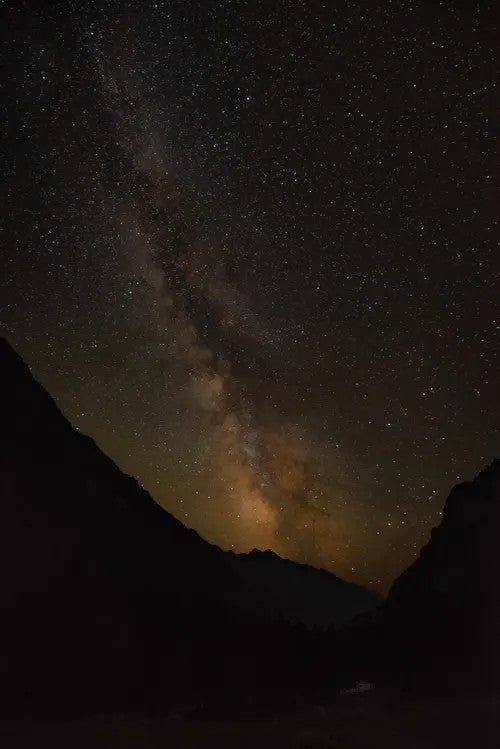
Milky Way photography in Colorado starts long before you press the shutter. The photo is made in the planning: picking the right week, the right direction, and the right foreground, then getting to a dark place on a clear, moonless night. Here is how to plan the shot.
First, know when the Milky Way is up
The bright core of the Milky Way is a seasonal sight. It sits in Sagittarius, low in the southern sky, and is only above the horizon at night from roughly March through October. It is at its best from June through August, up all night around the June solstice. By late October it sets soon after dark and is gone until spring.
From Colorado, at about 40 degrees north latitude, the core never climbs high. At its best it reaches roughly 21 degrees above the southern horizon. That is still plenty to photograph, as long as you have an open southern horizon.
Then there is the Moon. Go in the week around the new moon, when the sky is at its darkest. Even a half moon is bright enough to wash out the Milky Way. A full moon lights the landscape beautifully, but it will not give you the Milky Way.
Where to go in Colorado
Rocky Mountain National Park is the home base for this guide. The meadows of Moraine Park give you an open southern horizon with peaks as a foreground. Sprague Lake gives you a still lake that can reflect the sky on a calm night. Horseshoe Park on Fall River Road is the easiest drive-up option. Our spots guide covers each one in detail: https://estesparktourguides.com/blogs/news/best-stargazing-spots-rocky-mountain-national-park
Colorado has other dark sky country worth knowing about. Great Sand Dunes National Park in southern Colorado is a certified International Dark Sky Park, designated in 2019, with very dark skies over the tallest dunes in North America. The park is open around the clock for outdoor access, and night visits to the dunes are welcome. Black Canyon of the Gunnison is also a certified International Dark Sky Park, designated in 2015, and the park stays open at night. Check current conditions before you go, as the South Rim is still recovering from a July 2025 wildfire.
Wherever you go, arrive before dark. Scout your composition in daylight, find your foreground, and know where you will stand when it is black out.
Compose with the land, not just the sky
The Milky Way alone is a sky full of stars. What makes a Colorado Milky Way photo is the land underneath it: a ridgeline, a lake, a stand of pines. The best foregrounds are simple and dark, a shape against the sky rather than a busy scene. A lake reflection doubles the photo. A lone tree gives the frame scale.
Put the core low in the frame, with the foreground filling the bottom third. Walk the scene before dark and pick two or three compositions, then commit to one when the sky is ready.
The shoot itself
You need a tripod. There is no way around it. A camera on a tripod, a remote or a two second timer, and a lens as wide and as fast as you have. A common starting point is 20 seconds at f/2.8 and ISO 3200. Treat that as a starting point, not a recipe: take a test shot, look at it, and adjust from there. Shorter exposures keep stars round. Longer ones start to trail.
Focus is the hard part, because autofocus cannot see stars. Focus manually on a bright star or a distant light, then check the result by zooming in on the camera screen. Our guide to focusing on stars covers the full method: https://estesparktourguides.com/blogs/news/how-to-focus-on-stars-dslr-camera
Take more frames than you think you need, and take a few with the foreground lit briefly by a low red light, so you have options later. Keep your phone in your pocket and your screen dim.
Dress for cold, even in July. Standing still under a clear sky at altitude gets cold fast. A full checklist is here: https://estesparktourguides.com/blogs/news/what-to-bring-stargazing-rocky-mountain-national-park-checklist
After the shoot
The raw files are only the start. Editing is where the Milky Way photo comes together: lifting the shadows in the land and keeping the color honest. Our editing guide walks through the process step by step: https://estesparktourguides.com/blogs/news/editing-first-astrophotography-photo-without-purple
If you would rather learn the sky first and the camera second, our guided Stargaze tour runs on clear nights through the Milky Way season and beyond, and your guide can help you dial in settings: https://estesparktourguides.com/products/hikebyheadlamp
Quick answers
When is the best time to photograph the Milky Way in Colorado? New moon weekends in June, July, and August, between about 10 PM and 3 AM.
Where is the best place? Rocky Mountain National Park for mountain foregrounds, with an open southern horizon.
Go with a guide
If you would rather go with someone who knows the trails, the sky, and the seasons, our guides lead trips in Rocky Mountain National Park and around Estes Park every day. See the guided tours and pick the one that fits your trip.
-
Posted in
Astrophotography